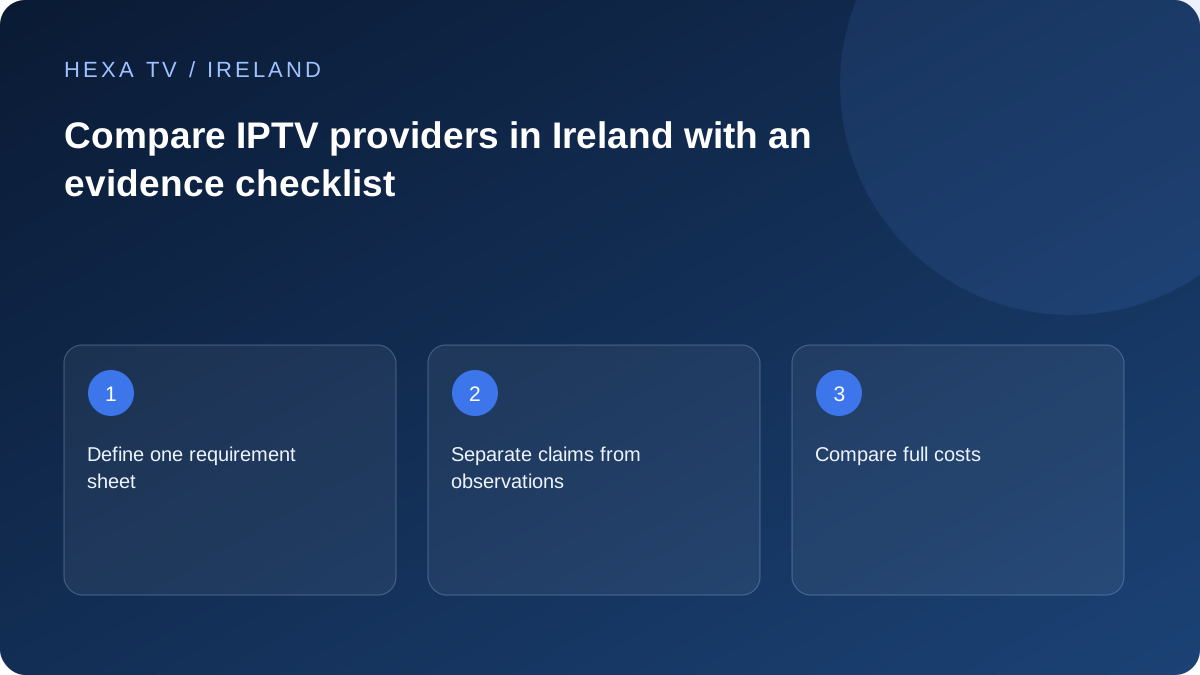
Use one requirement sheet for every provider
List the essential programmes, territory, devices, concurrent sessions and accessibility features. Ask every candidate about the same list. This prevents a large catalogue claim or promotional price from changing the criteria halfway through.
Give each answer a status: confirmed in current written terms, observed in a limited test, claimed in marketing, or unanswered. These categories should remain visible rather than being collapsed into an invented numerical score.
Put the full cost beside the scope
Compare duration, simultaneous streams, total, payment currency, renewal price and separate app charges. Keep hardware and broadband costs in their own rows. A low one-screen introductory total should not be compared with a longer multi-screen package as though they are equivalent.
The public competitor prices in the research receipt are observations of sales pages, not verified service quality or proof of rights. The HexaTV price matrix shows totals charged in euros; the price alone does not substantiate service quality or distribution rights.
Ask for specific support and catalogue answers
Request the current supported app for your exact model and the process when a programme stops working. If viewing hours matter, ask for documented support hours with timezone. '24/7' on a banner does not describe a tested response time.
For a must-have programme, verify its official viewing availability and ask the provider to identify the offered catalogue for your country. Do not infer inclusion from an illustrative logo or from another market's plan.
Use a trial record as limited evidence
Where a trial exists, test each provider on comparable hardware, connection and times. Note any differences in trial scope. If one supplies a restricted preview and another a broader account, mark the comparison as incomplete.
No hands-on provider ranking has been conducted for this guide. The original contribution here is the evidence sheet and decision method. Keep claims about measured quality, sales or licensing out of the conclusion until those checks exist.
Build a requirement sheet that belongs to your household
Begin with the five or six viewing items that would determine the purchase. Include exact programme or event names when a channel label is too broad, and record whether live, replay or on-demand access is required. Add language and accessibility needs.
Then list the exact devices and concurrent use. A provider that fits a new Google TV device but not the household's main television has not met the same requirement. Hold this sheet constant so marketing on the next website does not quietly redefine what you are comparing.
Keep different evidence types separate
The strength of a statement depends on its source and scope. None of these categories should be silently substituted for another.
| Evidence | What it supports | What it does not prove |
|---|---|---|
| Current written offer | The advertised scope and conditions | Independent service quality |
| Official app listing | A supported software distribution route | Every content account or source |
| Dated limited trial | The observed setup and session | Long-term reliability |
| Official broadcaster information | That broadcaster's viewing route | A reseller's distribution rights |
| Provider catalogue answer | A claim about the offered account | Every future programme |
| Public user comment | A reported experience or question | A representative performance rate |
Use the small Irish price sample carefully
The dated research receipt observed EmeraldIPTV advertising €12 for a month and €59 for a year for one screen, alongside several duration and device choices. Get IPTV Ireland's pricing page was also inspected as a separate local offer. These are provider sales-page observations, not endorsements or verified service results.
The pages illustrate why duration and screens belong together in a comparison. They do not establish that the services have identical catalogues, terms or supported players. Recheck any price and scope directly when making a decision; a research receipt is not a current payable quote.
Normalise the cost without inventing missing inputs
For each candidate, use one intended duration and screen allowance. Record full payable total, currency, any app fee, necessary hardware and the renewal mechanism. Mark an unanswered cost as unknown.
Calculate a monthly equivalent only after preserving the upfront payment and term. If you compare twelve repeated monthly payments, label the assumption about unchanged renewal prices. Do not convert a different currency using an unstated rate or compare a trial price with a full-term amount.
Compare an illustrative pair of offers
Imagine Offer A quotes a lower annual content price but requires a paid player, while Offer B has a higher content total and supports the household's existing setup. Before calling either cheaper, obtain the actual player cost and confirm that the important catalogue and simultaneous sessions are equivalent.
Now imagine Offer B cannot supply a required subtitle track. That changes suitability even if the price comparison is complete. The purpose of the example is to keep requirements and cost connected; it is not a claim about either named competitor or a recommendation of an untested service.
Check promises that sound measurable
Statements such as instant activation, round-the-clock help or a high uptime percentage should have an identifiable meaning and basis. Ask when activation begins, which support channel is covered and whether a stated response time exists.
Do not manufacture your own performance statistic from a handful of comments or one trial. A successful session can be useful evidence without becoming a reliability percentage. If the supporting method is unavailable, preserve the claim as unverified marketing.
Compare the support responsibilities
Determine whether the provider helps with its account only or also supports the named player and hardware setup. A player publisher may handle crashes while the content provider handles expiry and catalogue questions. Keep the routes separate.
Check the support hours that matter to the Irish household and ask for the timezone if it is unclear. A messaging icon, email address or chat widget proves only that a contact route is advertised, not that someone will answer within a particular period.
Inspect the conditions for change
Ask about replacing a device, increasing simultaneous use, moving home and renewing. Each can have a separate process or cost. A broad phrase such as multi-device does not answer all four.
Keep important responses alongside the actual offer and its date. Do not assume that a player licence transfers with a content account or that unused time becomes credit toward another term. These conditions can affect value more than a small difference in the first headline price.
Use an evidence-based final decision
For each essential requirement, write met, unmet or unconfirmed, with its supporting source. If a requirement depends on a limited observation, keep the test conditions. Avoid collapsing important unknowns into a score that looks more precise than the evidence.
Choose only after the remaining unknowns are acceptable for the commitment. The outcome can be to retain an official broadcaster route, resolve a device issue first or decline an offer. This guide is a comparison framework; no hands-on ranking or territorial rights certification of the providers has been performed.
Recheck the comparison when the decision changes
A saved comparison becomes stale when prices, device support, the desired event or household use changes. Update the affected rows rather than copying the old conclusion unchanged.
Keep the old receipt as historical evidence and the new offer separately. This makes it clear which conditions were in force at the point of choice and avoids presenting a previous market observation as a current guarantee.
Choose which unanswered question deserves the next effort
Not every missing detail matters equally. A required device that cannot install the app can end a comparison immediately; an optional menu preference may simply be a recorded limitation. Resolve the requirement that could change the decision before gathering more broad marketing information.
For example, if the household needs two simultaneous programmes and the provider has only answered a question about installed devices, ask for the concurrency rule. More catalogue screenshots will not resolve that gap. If the price is clear but the activation date is not, obtain the term-start answer before modelling cost per month.
This approach keeps the comparison efficient without treating incomplete evidence as complete. Retain an explicit unconfirmed status until the relevant answer or observation exists.