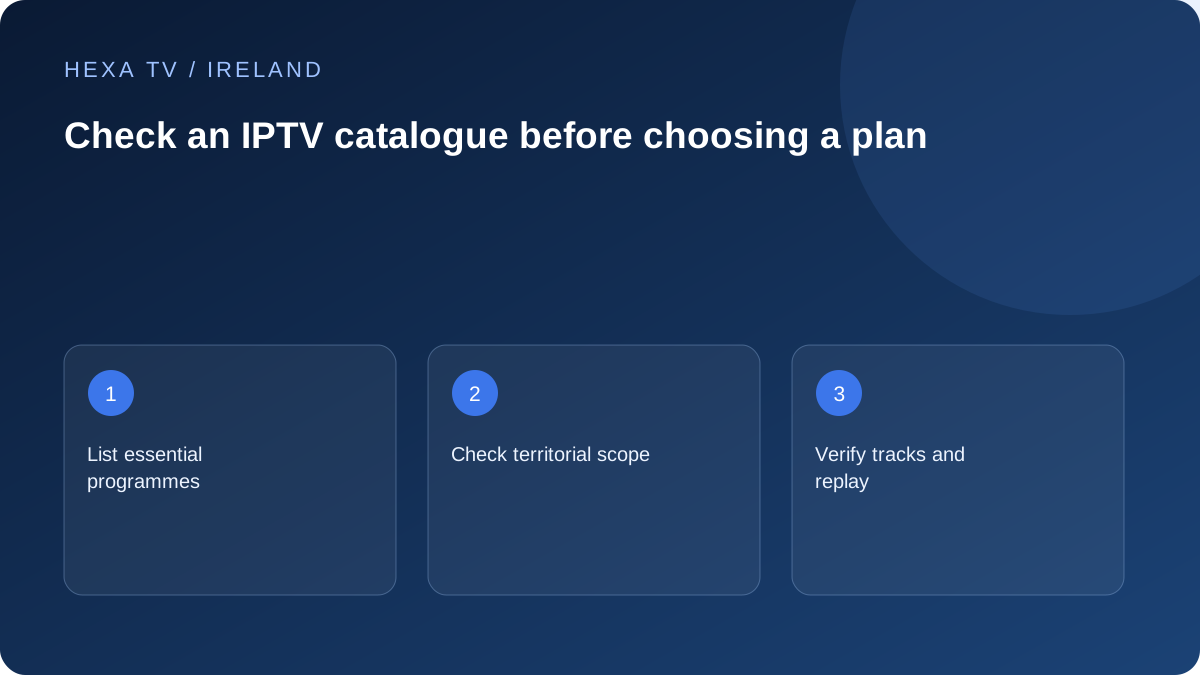
Build a short essentials list
Include the specific channels, events, programmes, languages and accessibility needs that would determine your purchase. A handful of essential items is more useful than browsing thousands of unfamiliar names.
Distinguish live, on-demand, replay and recording. A channel entry does not establish that every one of those modes exists.
Ask for the current offer in your country
Request a dated answer for your account and location. Another market's catalogue, an old screenshot or a logo on a homepage does not confirm present inclusion. Keep the answer with the plan details.
Where the programme has an official broadcaster or rights-holder route, check it directly as part of the comparison. This can clarify what a third-party offer would need to add.
Validate useful attributes
For each essential item, note resolution if it matters, available audio and subtitles, replay window and supported device. Separate provider claims from what you have actually observed in a limited trial.
If a catalogue list has duplicates, count the version you would use rather than treating every variant as a distinct benefit. A long list can still miss one crucial programme.
Keep changes visible
Before renewing, recheck the essentials list rather than assuming it is frozen for the life of the account. If an item disappears, record the current catalogue and ask the provider about the documented offer.
No verified HexaTV channel list or territorial distribution substantiation has been supplied for the Irish offer. Editorial references to broadcasters are not an inclusion promise.
Organise essentials by viewing job
A useful shortlist identifies what the household wants to do, not just brands it recognises. Write the exact programme, live channel edition or film version; whether live or replay matters; the preferred language; and the screen on which it will be watched. Keep optional items separate from requirements that would determine the purchase.
For example, a scheduled Irish bulletin on the main TV is a different requirement from short news clips on a phone. A full live sports fixture differs from highlights, and a film with the required captions differs from a similarly named version without them. The catalogue check should preserve those distinctions.
| Essential item | Attributes to record | Acceptable evidence |
|---|---|---|
| Live programme | Channel edition, date and territory | Current official or accountable service information for that exact source |
| Sports fixture | Competition, event, live or replay requirement | Current authorised viewing information and actual account scope |
| Film or series | Title, year, season and episode | Playable local programme listing rather than artwork alone |
| Accessibility need | Caption, audio-description or language requirement | Programme-specific availability on the intended device |
| Household use | Simultaneous screens and permitted location | Current account conditions |
| Replay need | Availability window and supported control | Specific replay information, not just an EPG entry |
Ask for the catalogue that applies to your account
A provider may publish different lists by country, package or date. Ask which current list applies to the exact proposed term and screen allowance. Preserve the date of the answer. Do not treat a screenshot circulating in a forum as a promise made to your household.
If the service cannot confirm an essential item, mark it unverified. That is a meaningful result, not a gap to fill with an optimistic assumption. A large total can include repeated editions, quality variants or items irrelevant to the household, so it is not a substitute for the small essentials list.
Distinguish information from proof of playback
A current listing tells you what the service represents as available. A supported demonstration can show what played on a particular device at a particular time. Neither alone establishes long-term availability, every advertised feature or the provider's distribution rights.
Keep each observation labelled. If a title was only listed, do not describe it as tested. If it was tested on a tablet, do not silently convert that into a living-room TV result. A clear record of the evidence is more useful than a simple yes beside every item.
Inspect the feature attached to the programme
Check the actual audio and subtitle options, live versus on-demand form, and any replay or resume controls required. The player may support a feature generally while the source does not supply it for this item. A guide listing likewise does not create a catch-up recording.
For official Irish services, use the broadcaster's programme and accessibility information. TG4's own FAQ discusses availability subject to programme rights. That evidence belongs to TG4's service; it should not be used to certify a third-party copy or an unrelated subscription catalogue.
Keep terrestrial and official app routes in the comparison
If a working Saorview setup or official broadcaster app already meets an essential requirement, record that route. A proposed paid subscription should be evaluated for what it adds, not assumed to be the only way to watch every familiar Irish programme.
Compare convenience honestly. One route may offer the desired programme with a familiar remote, while another may require changing inputs or using a separate app. That practical difference can matter, but should be assessed on the actual household device rather than inferred from marketing language.
Recheck a changing catalogue without rebuilding the whole list
At renewal or before a time-sensitive purchase, revisit the essentials and any known changed items. Keep the old date and result so the difference is visible. There is no need to audit thousands of irrelevant entries to decide whether a specific household need is still met.
If a title disappears, ask whether it has moved, changed name, expired or is outside the account's current scope. Do not invent the explanation. Preserve the actual offer and response if the change affects the purchase decision, and use the appropriate service process for commercial questions.
Make the plan decision from the verified shortlist
Choose a duration and screen allowance only after the essential scope is clear enough for the household's intended commitment. More screens do not add an absent programme, and a longer term does not prove future rights or availability.
A compact final record can show each essential as confirmed by current information, observed in a limited test, unavailable or unresolved. State which unresolved item prevents a confident choice. This makes it possible to choose a suitable plan, wait for an answer or use another authorised route without pretending that catalogue size alone settled the question.